
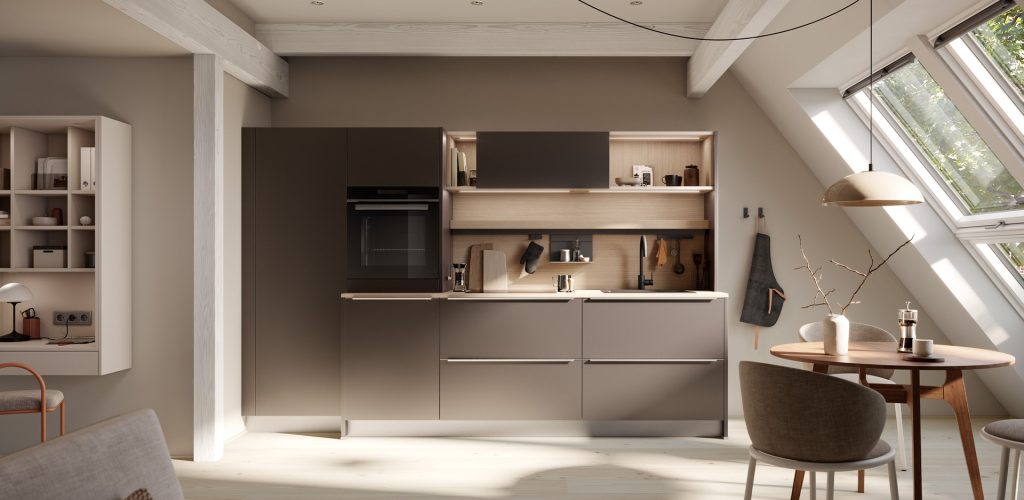
Kitchen Tapware Guide: Types, Finishes and Costs
Kitchen tapware is the tap, mixer or faucet fitted to your sink, along with its handle, spout and any pull-out or filter…

A shaker kitchen is defined by its five-piece framed cabinet doors: two vertical stiles, two horizontal rails and a recessed flat centre panel held together with clean, square edges. It is one of the most recognised kitchen styles in the world, valued equally in traditional homes and contemporary open-plan spaces.
Häcker’s lacquer shaker doors (models 5045 and 5085) are machine-made in Germany to precise tolerances, delivering a finish consistency and lacquer durability that flat-pack and inconsistently manufactured shaker cabinets cannot match. Every door leaves the Rödinghausen factory with uniform panel alignment, consistent edge profiles and a lacquer surface engineered to resist chips, scratches and discolouration over years of daily use.
Whether you are drawn to a classic white shaker kitchen or a contemporary design in deep matte tones, Häcker gives the shaker profile a level of precision that only German engineering can deliver.
What Defines a Shaker Kitchen?
The shaker kitchen style takes its name from the Shaker community, a religious group active in 18th and 19th century America. Their furniture philosophy was direct: build only what serves a purpose, and strip away anything that does not. That principle produced the five-piece framed door that remains the single clearest identifier of a shaker kitchen today.
A true shaker cabinet door is built from five components:
The result is a clean, geometric profile with square inner edges and no ornamental moulding. This simplicity is precisely what makes the style so versatile: it carries enough visual structure to feel intentional, without locking a kitchen into a single era or aesthetic.
Shaker kitchens have outlasted almost every design trend of the past century. The reason is adaptability. Pair a shaker front with brushed brass knobs and a warm timber benchtop and the kitchen reads as classic. Swap to a matte lacquer finish with integrated bar handles and engineered stone, and the same door profile feels entirely contemporary. Few kitchen styles can move between those two poles without losing their identity.
Shaker Kitchen Cabinets: What Separates Premium from Budget
Not all shaker kitchen cabinets are built to the same standard. The door profile may look similar across price points, but the construction behind it determines how the kitchen performs, feels and lasts over 10, 15 or 20 years of daily use. Understanding what sits inside and behind the door is the fastest way to judge real quality.
Premium shaker cabinets start with the carcass (the box behind the door). Häcker builds cabinet boxes from moisture-resistant engineered board with a minimum thickness of 19 mm, finished on all visible faces. Hinge systems use concealed, soft-close European hinges rated for tens of thousands of cycles. Drawer runners are full-extension, soft-close units that hold weight evenly across the full depth of the drawer, not partial-extension slides that limit access to the rear half.
The difference between a functional kitchen and a frustrating one often sits inside the cabinet rather than on the front of it. Pull-out larders, internal drawer organisers, corner carousel systems and under-sink storage solutions transform dead space into usable capacity. Häcker’s intelligent storage systems are designed as integrated components, not aftermarket add-ons, so they fit precisely within each cabinet module.
Budget shaker kitchen furniture typically uses thinner carcass material, cam-lock assembly, partial-extension runners and basic hinges. These components are adequate at the point of purchase but degrade noticeably within a few years. German-engineered cabinets like Häcker’s are built with dowel-and-glue construction, full steel drawer systems and hardware rated for commercial-grade cycle counts, all inside a cabinet that was designed, cut and assembled by machine to sub-millimetre tolerances.
| Feature | Premium (Häcker) | Budget / flat-pack |
| Carcass material | 19 mm moisture-resistant board, finished all faces | 16 mm standard board, often raw rear face |
| Assembly method | Dowel-and-glue, factory-assembled | Cam-lock, flat-pack self-assembly |
| Hinge system | Concealed soft-close, tool-free adjustment | Basic concealed hinge, limited adjustment |
| Drawer runner | Full-extension, soft-close, high weight rating | Partial-extension, no soft-close |
| Internal storage | Integrated pull-out larders, corner carousels, organisers | Basic shelves, aftermarket inserts |
| Warranty | Manufacturer-backed, multi-year coverage | Limited or retailer-only warranty |
Shaker Kitchen Doors: Profiles, Materials and Finishes
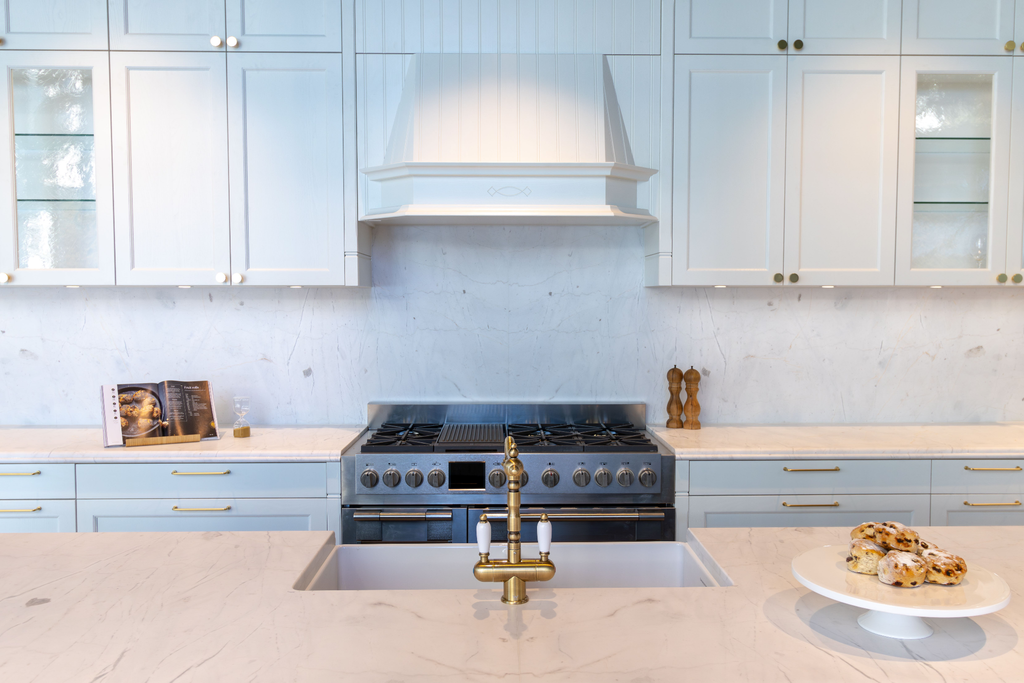
The door is the most visible surface in any shaker kitchen, and its material, finish and construction define how the kitchen looks, feels and ages. Häcker offers shaker kitchen doors in precision-lacquered profiles that bring the classic five-piece frame into a premium, contemporary context.
Häcker manufactures two lacquer shaker door models for the Australian market:
Both models are manufactured in Häcker’s Rödinghausen factory using automated spray and curing lines that apply lacquer in controlled, dust-free conditions. The result is a uniform colour depth and surface smoothness that hand-sprayed doors cannot consistently replicate. Machine-made tolerances mean every door in a run matches every other door, whether it is the first or the fiftieth.
The lacquer finish is engineered for durability: resistant to moisture, UV yellowing and everyday surface contact. Maintenance is straightforward, requiring only a damp cloth and mild detergent to keep the surface clean.
When evaluating shaker kitchen cabinet doors side by side, focus on three areas:
| Property | Lacquer (Häcker 5045 / 5085) | Painted MDF | Timber veneer |
| Finish quality | Factory-sprayed, flawless surface | Hand- or machine-sprayed, minor variation | Natural grain, some inconsistency |
| Durability | High UV and moisture resistance | Moderate, can chip at edges | Vulnerable to moisture and UV without sealing |
| Maintenance | Damp cloth, mild detergent | Requires care to avoid chipping | Periodic re-oiling or re-sealing |
| Colour consistency | Identical across full production run | Batch variation possible | Natural grain variation (by design) |
| Cost | Premium | Mid-range | Mid to premium depending on species |
Shaker Kitchen Colour and Design Ideas
Colour transforms the character of a shaker kitchen more dramatically than almost any other single decision. The same five-piece door profile reads as completely different kitchens depending on whether it is finished in classic white, deep matte black or a rich navy blue. Browse completed projects in our kitchen gallery for real examples.
White remains the most popular shaker kitchen colour in Australia, and for good reason. A white lacquer shaker front reflects natural light, visually expands the room and pairs with virtually any benchtop material, from Carrara marble to warm timber. In open-plan Australian homes where the kitchen faces the living area, white shaker cabinets create a clean, bright backdrop that does not compete with the rest of the space.
For a premium result, Häcker’s lacquer white finish delivers a depth and uniformity that painted white simply cannot match. There is no brushstroke texture, no yellowish undertone from cheaper sealers, just a consistent, luminous surface across every cabinet.
A black shaker kitchen makes a bold statement, particularly in matte lacquer. The flat, light-absorbing surface highlights the geometry of the five-piece frame, turning each door into a subtle shadow play of depth and line. Black works best in kitchens with strong natural light or where warm materials like timber, brass or stone provide contrast.
Pair black shaker cabinets with a light stone benchtop and brushed brass hardware for a look that balances drama with warmth. In larger kitchens, consider a two-tone approach: black base cabinets with white or timber upper cabinets to prevent the room from feeling closed in.
Blue shaker kitchens have gained steady interest among Australian homeowners looking for personality without the intensity of black. Navy and deep teal tones pair naturally with the shaker profile, adding richness while staying grounded. Lighter blues, from powder to duck egg, suit coastal and country-inspired spaces.
Häcker’s lacquer range offers the advantage of colour precision: the shade you approve is the shade manufactured, with no batch variation across your full kitchen.
Two-tone shaker kitchens, typically pairing a darker base with lighter uppers, add visual interest and help define zones in larger open-plan layouts. Popular Australian pairings include:
Hardware choice completes the palette. Brushed nickel or chrome suits contemporary shaker kitchens. Brushed brass or aged bronze leans warmer. Integrated bar handles maintain clean lines, while classic round knobs reinforce the traditional shaker character.
Contemporary Shaker Kitchen Design
A contemporary shaker kitchen keeps the five-piece door profile but strips back everything around it. The framing stays. The ornamentation, fussy hardware and heavy timber go.
The shaker door itself is the constant: square edges, recessed flat panel, geometric frame. In a contemporary interpretation, the surrounding choices shift entirely.
| Element | Traditional shaker | Contemporary shaker |
| Door finish | Painted timber, satin or eggshell | Lacquer, ultra-matte or soft-touch |
| Colour palette | Whites, creams, heritage greens | White, grey, charcoal, black, navy |
| Hardware | Round knobs, cup pulls, visible hinges | Integrated bar handles, push-to-open, concealed hinges |
| Benchtop | Timber, honed granite | Engineered stone, porcelain, ultra-compact surfaces |
| Layout | Freestanding, unfitted elements | Fully integrated, island-centric, open-plan |
| Storage | Open shelving, plate racks, freestanding dressers | Concealed pull-out systems, integrated pantry towers |
Häcker sits naturally in the contemporary lane. The 5045 and 5085 lacquer shaker doors pair German precision with a door profile that has existed for over two centuries, bridging heritage and modernity in a single surface. Combine them with the Systemat handleless rail system or integrated bar handles, intelligent internal storage and a streamlined island layout, and the result is a shaker kitchen that feels unmistakably current.
This is the positioning that separates Häcker from both budget flat-pack shaker ranges (which lack the build quality to deliver a premium contemporary result) and traditional bespoke joiners (who lean into heritage storytelling and artisan positioning). Häcker offers the shaker profile engineered for the way contemporary Australian kitchens are actually used: open-plan, high-traffic, design-forward.
Designing a Shaker Kitchen for Australian Homes
Australian homes demand something different from a shaker kitchen than a London terrace or a New England farmhouse. Open-plan living, indoor-outdoor flow, strong natural light and a climate that tests materials year-round all shape how a shaker kitchen should be designed here.
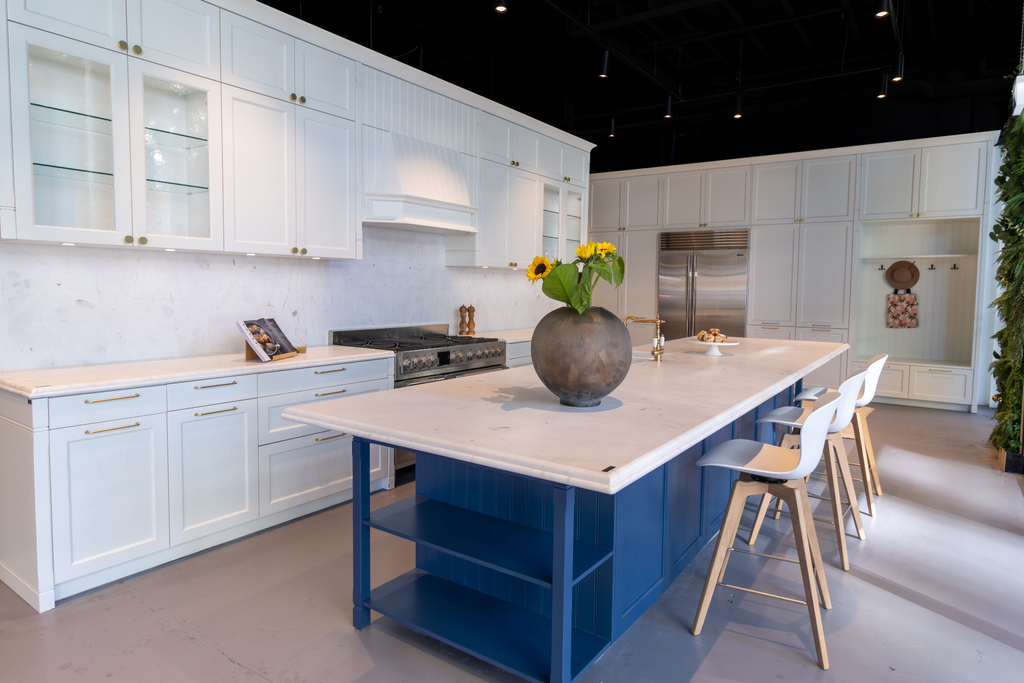
The kitchen island is central to most Australian open-plan layouts, serving as preparation space, casual dining area and the visual anchor of the room. A shaker kitchen built around a generous island, with tall integrated pantry storage along the back wall, maximises both function and sightline. Our case studies show how this works in real Australian homes
For smaller spaces, galley and L-shaped layouts keep the efficient shaker philosophy intact. The clean lines of the five-piece door work well in compact kitchens because the profile adds visual interest without the bulk of raised-panel or ornamental alternatives.
Lacquer finishes are particularly well suited to Australian conditions. Unlike painted timber, lacquer resists the moisture fluctuations that come with coastal humidity and inland dry heat. UV-resistant lacquer formulations maintain colour stability even in north-facing kitchens that receive strong direct sunlight through much of the year.
Seeing and touching a shaker door in person is the fastest way to understand the difference precision engineering makes. Häcker Australia has showrooms in three locations:
Book a complimentary design consultation to explore how a shaker kitchen can work in your home. Contact the team at [email protected] or visit your nearest showroom.
FAQ
Shaker kitchen style is defined by five-piece framed cabinet doors with a recessed flat centre panel and square edges. The design originated with the Shaker community in 18th century America, where furniture was built around the principle that form should follow function with no unnecessary decoration. Today, the style is one of the most widely used kitchen door profiles in the world.
The name comes from the Shakers, a religious community (formally the United Society of Believers in Christ’s Second Appearing) active in America from the mid-1700s. Their furniture, including kitchen cabinetry, rejected ornamentation in favour of clean lines and honest construction. The five-piece framed door they developed became so distinctive that it carried the community’s name into modern kitchen design.
A shaker door has a five-piece frame (two stiles, two rails) surrounding a recessed centre panel, creating a visible border and shadow line. A flat-panel (slab) door is a single, completely flat surface with no frame or recess. Shaker adds geometric structure and visual depth. Flat-panel prioritises minimalism and seamless lines. Häcker offers both profiles, so the choice comes down to the design direction of your space.
Absolutely. A contemporary shaker kitchen retains the five-piece door profile but pairs it with lacquer finishes, integrated or handleless hardware, concealed storage and streamlined layouts. The frame geometry of the shaker door actually benefits contemporary spaces by adding subtle visual interest to what might otherwise be an entirely flat kitchen front. Häcker’s 5045 and 5085 lacquer shaker doors are specifically designed for this contemporary interpretation.
White is the most searched and most specified shaker kitchen colour in Australia. It reflects light, suits open-plan living and pairs with virtually any benchtop or hardware finish. That said, darker tones (charcoal, navy, matte black) are gaining ground, particularly in contemporary layouts where the shaker frame creates a subtle interplay of shadow and depth. Two-tone combinations, pairing a darker base with lighter uppers, are also increasingly popular.

Kitchen tapware is the tap, mixer or faucet fitted to your sink, along with its handle, spout and any pull-out or filter…
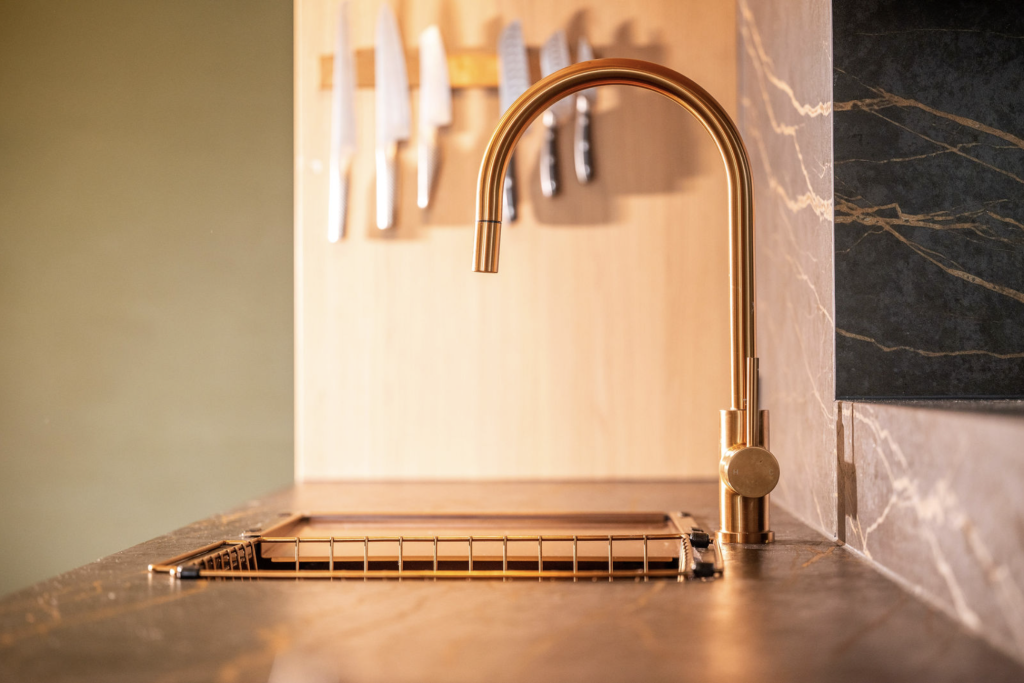
A kitchen sink design is the combination of bowl configuration, mounting style and benchtop placement that determines how a sink looks and…
A country kitchen, a shaker kitchen and a modern German kitchen solve the same problem in three different ways: how much visual…